
In the world of football, Lionel Messi's genius has always been defined by his magical left foot, his mesmerizing dribbling, and his unparalleled playmaking vision. For years, a common narrative painted him as a player who conserved his energy, focusing his immense talent almost exclusively on the offensive side of the game. The perception was that defensive work rate, particularly the high-intensity pressing demanded of modern forwards, was not a part of his legendary toolkit. Critics would often point to this as a minor flaw in an otherwise perfect player, especially during Barcelona's less dominant phases. However, as the game has evolved into 2026, with data analytics becoming more sophisticated and integral to understanding performance, a fascinating statistical revelation has emerged that completely flips this long-held assumption on its head.
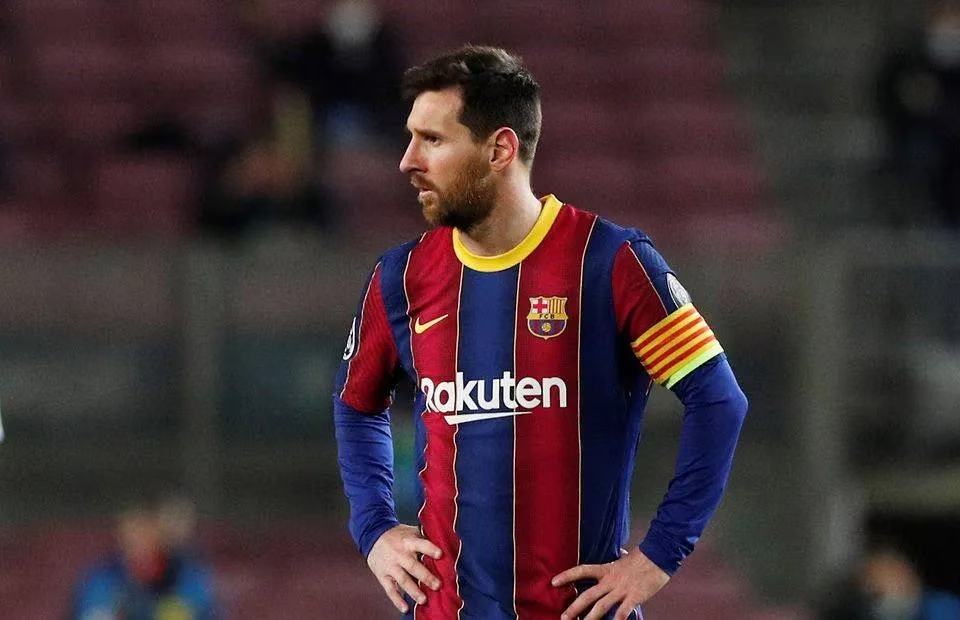
Recent analysis, drawing from comprehensive data sources like FBref, has placed Messi among the footballing "aristocracy"—a select group of the eleven most elite forwards from Europe's top five leagues—to scrutinize their pressing effectiveness. The metric is simple yet revealing: it calculates the percentage of a player's defensive pressures that directly result in the team recovering possession. This goes beyond just running; it measures intelligent, impactful defensive actions. The results are startling for anyone who bought into the old stereotype. Lionel Messi doesn't just participate in pressing; he does it with remarkable efficiency, ranking a stunning second in the entire group.
The Efficiency Rankings: A Closer Look 🏆
The data tells a compelling story. Topping the list is the relentless Robert Lewandowski, whose 34.1% effectiveness rate sets a high bar. But hot on his heels is Messi himself, with a 33% effectiveness rate from 209 pressures, leading to 69 ball recoveries. This means that roughly one out of every three times Messi applies defensive pressure, his team wins the ball back—a rate higher than renowned workhorses and younger superstars alike.
Let's break down the full ranking for clarity:
| Rank | Player | Ball Recoveries | Pressures Applied | Effectiveness Rate |
|---|---|---|---|---|
| 1 | Robert Lewandowski | 73 | 214 | 34.1% |
| 2 | Lionel Messi | 69 | 209 | 33.0% |
| 3 | Neymar | 53 | 159 | 32.7% |
| 4 | Mohamed Salah | 114 | 365 | 31.2% |
| 5 | Erling Haaland | 63 | 205 | 30.7% |
| 6 | Kylian Mbappé | 39 | 135 | 29.9% |
| 7 | Zlatan Ibrahimović | 25 | 84 | 29.8% |
| 8 | Cristiano Ronaldo | 34 | 131 | 26.0% |
| 9 | Marcus Rashford | 51 | 209 | 24.4% |
| 10 | Luis Suárez | 29 | 129 | 22.5% |
| 11 | Karim Benzema | 35 | 173 | 20.2% |
Beyond the Percentage: Contextualizing the Numbers
The table reveals several key insights that reshape how we view these global icons:
-
Quality Over Quantity: While Liverpool's Mohamed Salah, under Jurgen Klopp's famed system, applied a mammoth 365 pressures (far more than anyone else), his effectiveness rate, though strong, sits at 31.2%. This highlights a crucial point: Messi's pressing is not about sheer volume but about precision and timing. He chooses his moments with a playmaker's intelligence, making his interventions count.
-
Outperforming Peers: Messi's ranking is particularly notable when compared to his direct contemporaries and rivals. He places significantly above Kylian Mbappé (6th) and Cristiano Ronaldo (8th) in pressing effectiveness. He also applies more total pressures than Mbappé, Ronaldo, Neymar, Luis Suárez, and even the phenomenally energetic Erling Haaland.
-
The Intelligence Factor: This data debunks the "lazy" label completely. It suggests Messi's defensive contribution is cerebral. He isn't mindlessly chasing shadows; he is reading the game, anticipating passing lanes, and applying pressure where it will most disrupt the opponent's build-up. His recoveries often occur in dangerous areas, instantly turning defense into a lethal attacking opportunity—a hallmark of his game.
The Evolution of a Legend in 2026
As of 2026, this analysis is more relevant than ever. The game continues to demand more from every player on the pitch, and the data proves Messi has adapted without sacrificing his unique style. He embodies the concept of "effective effort." This statistical profile adds a new layer to his enduring legacy. It shows that his footballing IQ permeates every phase of play. He understands that winning the ball high up the pitch is as valuable as a killer pass. For coaches and analysts, it's a masterclass in economical yet devastating defensive contribution.
For fans and pundits, it's a reminder that greatness often defies simple categorization. 🧠⚽ The narrative must now evolve: Lionel Messi isn't just an offensive deity; he is a supremely efficient defensive disruptor whose every action on the field, whether with the ball at his feet or without it, is calculated for maximum impact. The numbers, as they so often do, have spoken—and they tell a story of an all-around genius whose work rate was always smarter than it looked.
Comments