
As the 2026 European football season unfolds, Ange Postecoglou's Tottenham Hotspur continues to be a compelling study in contrasts. The North London club, under the Australian manager's guidance, has carved a path into the Europa League's Round of 16 with an automatic qualification that speaks to resilience over seamless execution. Their journey through the revamped league phase—securing fourth place with five wins from eight matches—highlights a team capable of collecting points even when not firing on all cylinders. This achievement, shared with fellow Premier League representative Manchester United who also bypassed the play-off round, underscores the strength of English clubs in the competition's new format. Yet, a deeper dive into their campaign reveals a surprising narrative: their progress has been achieved in spite of fielding what statistical analysis deems the competition's most underperforming player.
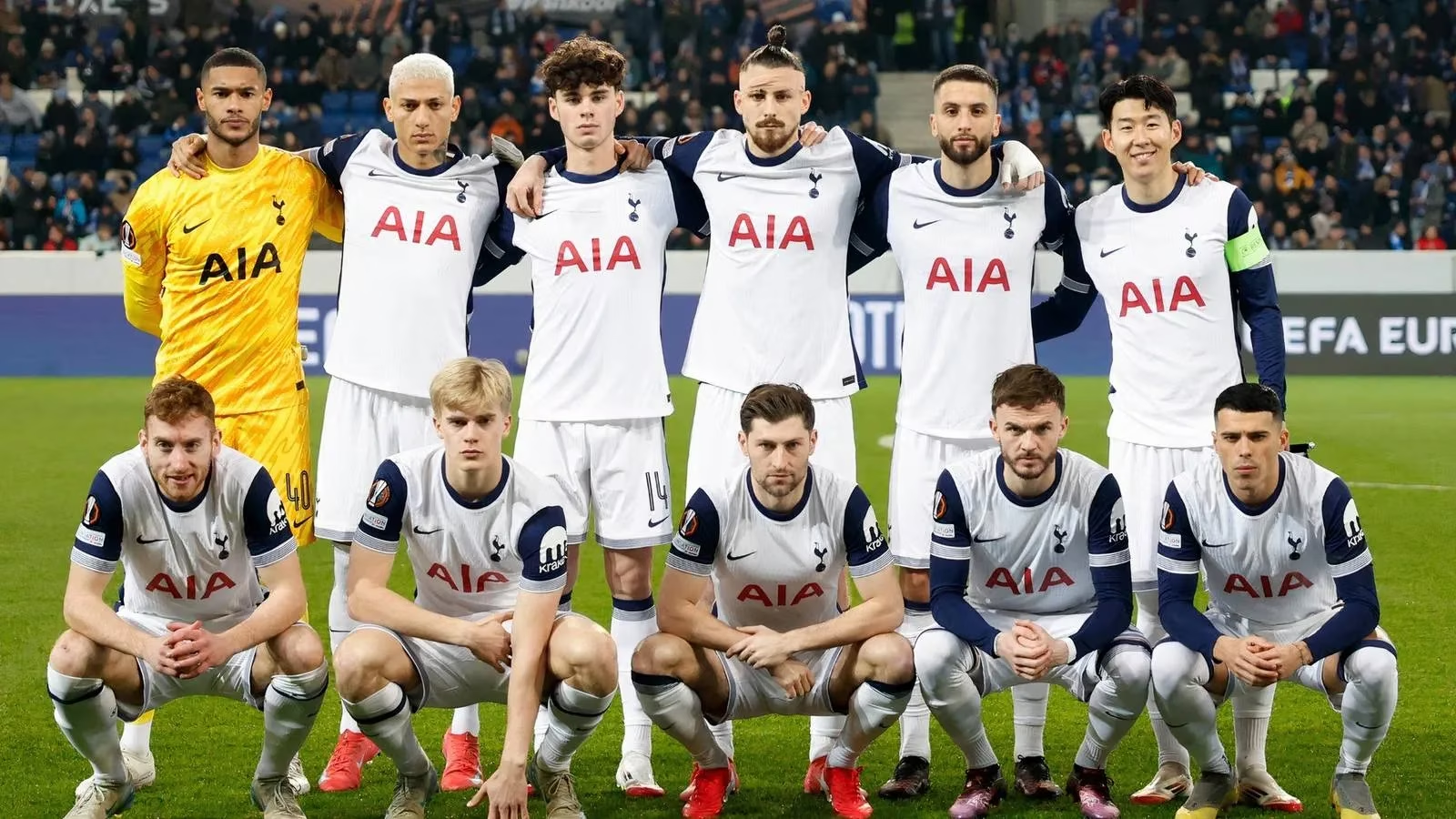
The statistical spotlight, as reported by Sofascore, falls unflatteringly on central defender Radu Dragusin. With an average rating of just 6.11 across the 2024/25 league phase, the Romanian international finds himself at the bottom of the performance rankings for all players in the competition. This places him below even the likes of Rangers' Cyriel Dessers and Hoffenheim's Oliver Baumann, who feature in the statistical 'worst-performing XI'. For a club that finished in the top four of its group, boasting victories over Qarabag FK, Ferencvaros, AZ Alkmaar, and a dramatic 3-2 win over Hoffenheim, the presence of such a low-rated regular contributor is paradoxical. It begs the question of how a team manages to 'cruise' into the knockout stages while carrying, statistically, the competition's weakest link.
Postecoglou's system is famously demanding, especially for defenders. The high-line, possession-based approach requires immense discipline, pace, and technical comfort on the ball. The transition from Serie A, where Dragusin was once hailed as 'one of the most interesting young defenders,' to the relentless pace and spatial demands of Postecoglou's Premier League and Europa League setup has proven, in his case, to be a chasm. His struggles are not merely a matter of form but appear to be a systemic fit issue. Compounding this has been necessity; injuries to first-choice centre-backs Micky van de Ven and Cristian Romero have forced the manager's hand, often pairing Dragusin with midfielder-turned-defender Archie Gray—a makeshift solution that has somehow yielded results.
Dragusin's campaign has been punctuated by moments that have cratered his rating. His season in Europe began in the worst possible fashion: a red card just eight minutes into the 3-0 victory over Qarabag. Later, in a match against Elfsborg, a halftime substitution led only to an injury in the 66th minute, offering another brief, ineffective cameo. These episodes, while not defining the entire group stage, have undoubtedly skewed his metrics downward and limited his opportunities to build rhythm and confidence.
Despite this glaring individual struggle, Tottenham's collective engine has kept running. The team's ability to score goals and win games—even when conceding, as in the 3-2 loss to Galatasaray and the 2-2 draw with Roma—has been their salvation. It speaks to a potent attack and a midfield that can control large portions of games, thereby shielding a vulnerable defense. Postecoglou's historical precedent adds another layer of expectation. The manager has publicly noted that he typically wins silverware in his second season at a club. This Europa League run, therefore, is seen as the opening act of a promised trophy charge, making their ability to advance despite defensive woes all the more critical.
As Tottenham awaits its Round of 16 fate, the draw presents familiar and new challenges. Their next opponent will be one of the play-off winners: Real Sociedad, Galatasaray (who already beat them), Midtjylland, or AZ Alkmaar (whom they narrowly defeated). This next phase will be the true test of whether their formula of outscoring problems remains viable. The knockout rounds are less forgiving; individual errors are punished more severely, and the tactical spotlight intensifies.
For Dragusin, the road ahead is about adaptation and redemption. The physical and tactical demands of English football, combined with Postecoglou's specific philosophy, have been a steep climb. His journey reflects a broader theme in modern football: the intense scrutiny of data and the sometimes-contradictory story it tells when compared to team results. Tottenham's Europa League story so far is one of resilient success, a narrative built not on defensive solidity, but on a collective will that has, thus far, managed to overcome its most significant statistical weakness. Whether that can continue deep into 2026's knockout stages remains the season's most intriguing subplot.
Comments